Consider the wide variety of misinformation on the Internet that you have to wade through to find reliable information and news.
- Misinformation: False information that is spread regardless of an intent to mislead.
- Disinformation: False claims and information and conspiracy theories that are spread with the intent to mislead. Propaganda.
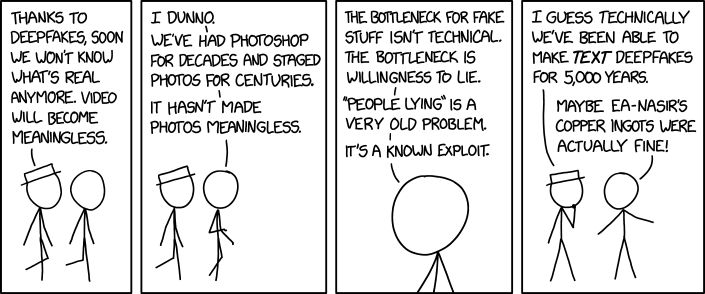
- Deepfakes and shallowfakes: Use of video software to create events that never happened or distort a person's statements for propaganda purposes or to discredit public figures for political or financial gain. xkcd wisdom on deepfakes
- Satire: Sources that use humor, irony, exaggeration, ridicule, satire, and false information to comment on current events.
- State-sponsored False Information: Sources, particularly in repressive or authoritarian states, operating under government control that create and spread disinformation and propaganda.
- Junk Science: Sources that promote discredited conspiracy theories or scientifically false or unverifiable claims.
- Hate on the Internet: Sites that actively promote racism, misogyny, homophobia, white supremacy, and other forms of violence, bias, and exclusion.
- Fake News: Content from sources that entirely fabricate information, disseminate disinformation and deceptive content, or grossly distort actual news reports.
- Clickbait: Sources that use exaggerated, misleading, or questionable headlines, social media descriptions, and/or images to generate traffic on a website.
And even news and information that looks reliable because of where you found it should still be verified.
- Proceed With Caution: Sources that may be reliable but whose contents require further verification.
- Political: Sources that provide generally verifiable information in support of certain points of view or political orientations.
- Credible: Sources that circulate news and information in a manner consistent with traditional and ethical practices in journalism. (Remember: even credible sources sometimes rely on clickbait-style headlines or occasionally make mistakes. No news organization is perfect, which is why a healthy news diet consists of multiple sources of information).
Adapted from Cornell University's "Fake News, Propaganda, and Misinformation: Learning to Critically Evaluate Media Sources: Unreliable News Content - Types"
Research & Learning Services
Olin Library
Cornell University Library
Ithaca, NY, USA